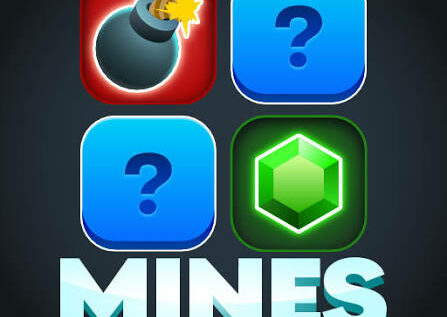

Mines is a 5×5 grid game by Spribe. Reveal gems to raise your multiplier, avoid hidden mines, and cash out any time. You pick the mine count to set risk. Advertised RTP: 97% at most casinos.
Mines is one of the simplest instant-win formats in online casino gaming: reveal tiles on a grid, avoid the hidden mines, and cash out before your luck runs out. It sits in the same provably fair family as Aviator and JetX, but the risk curve works differently — instead of watching a multiplier climb on its own, you control it tile by tile, one click at a time.
This Mines game review skips the marketing copy and goes straight to what actually determines your results: the real RTP, how mine count changes your odds, and how to verify a round wasn’t rigged.
The setup is the same across almost every version of the game: you pick a bet size, choose how many mines to hide on the grid, then start revealing tiles one at a time. Each safe tile pushes a multiplier a little higher. Hit a mine, and the round ends — you lose whatever you hadn’t already cashed out.
There’s no skill in guessing tile locations — the outcome is set before the first click. What you actually control is risk exposure: how many mines you set, and when you stop clicking.
RTP is not standardised across every Mines clone — each studio or casino can license its own build with its own payout math, so the number printed on one site isn’t automatically true on another. According to Spribe’s official Mines page — the studio that popularised the format in 2021 — the game lists a Return to Player of 97%, a 1-to-20 mine range, and a maximum win capped at 10,000x the stake.
A 97% RTP means a 3% house edge over the long run, which is broadly in line with what you’d expect from a well-built instant-win title — better than most standard slots, worse than blackjack played with correct strategy. The important habit is checking the specific RTP disclosure on whichever platform you’re actually playing on, rather than assuming every “Mines” listing pays the same.
Spribe documents its regulatory testing status on its own licensing and certification page, which lists the RNG and game certificates issued per jurisdiction — including a test report built to the GLI-19 standard for its Greek licence. We could not locate a single, publicly downloadable iTech Labs, eCOGRA or GLI certificate covering Mines specifically; the certification references above apply to the regulated markets where the game is licensed, not a standalone seal for this one title.
Last verified: October 2026.
The number of mines you set is the single biggest lever you control, and it works as a direct trade-off:
One detail catches new players off guard: your expected loss per unit wagered doesn’t actually change based on how far you push your luck before cashing out. The mine count changes how the risk feels — spread thin over many small decisions, or concentrated into one high-stakes click — not the underlying edge built into the game.
Provably fair is the mechanism that lets you confirm, after the fact, that the mine positions weren’t adjusted once you started clicking. The layout is generated from a cryptographic seed before your first move; once the round ends, that seed can be checked against the result to confirm nothing changed mid-round.
This is also why “Mines predictor” tools and paid signal groups are a scam by construction — no browser extension or algorithm can know a seed-based layout in advance, and any tool claiming otherwise is selling a guess, not an edge. Legitimate providers publish the verification steps directly on the game itself; if a version of Mines you’re using doesn’t offer any way to check a seed after the round, that’s a bigger red flag than the RTP number.
If you already understand how randomness and payout verification work in a title like Aviator or JetX, Mines will feel familiar — both rely on the same RNG and provably fair foundations covered in our full breakdown of how online casino games really work. The difference is pacing: a crash multiplier climbs automatically and you time an exit, while Mines forces a deliberate decision on every single tile. Players who prefer control over reflexes tend to gravitate toward Mines; players who like watching a number climb tend to stick with crash formats.
For a wider view of how Mines compares to other instant-win and provably fair titles on this site, see our full casino games directory.
Rating: 4.1/5 — a solid, transparent format for players who want a fast, low-complexity game with a verifiable outcome.
Mines earns its place in a provably fair rotation alongside crash games — just confirm the RTP disclosure on your specific platform before you assume it matches the 97% figure published by the game’s original creator.
Yes, in its original and most licensed versions — the mine layout is generated from a cryptographic seed before the round starts, and that seed can be checked afterward to confirm it wasn’t altered mid-game.
On Spribe’s official version, the RTP is published at 97%. Other studios and casinos running their own build of the game can set a different RTP, so it’s worth checking the specific platform’s disclosure rather than assuming every Mines game pays the same.
It changes how risk is distributed across a round — fewer mines means smaller, more frequent gains and higher survival odds per click; more mines means rare but larger multipliers. The underlying house edge stays the same regardless of the mine count you pick.
No. Because the layout is fixed by a cryptographic seed before you make your first click, no external tool can know or influence it in advance — any product marketed as a Mines predictor is a scam.







Independent casino game and operator reviews — real RTP data, honest mechanics breakdowns and bonus details, verified wherever we could confirm them. 18+. Gamble responsibly.