

Plinko drops a ball through a pegboard into multiplier slots. Pick your risk level and number of rows, then watch it bounce. Simple and fast; RTP varies by provider, so read the rules first.
Plinko has become one of the most played instant-win games across African casino platforms, sitting right alongside Aviator and Spaceman in most game lobbies. Rather than a climbing multiplier you have to cash out before it crashes, Plinko drops a ball through a field of pegs and pays out the moment it lands. This review covers the official Plinko game RTP, how the provably fair system actually verifies a drop, what the risk buttons really change, and our final verdict.
The board is a triangle of pegs stacked above a row of payout slots. You set a stake, choose a risk setting, and drop a ball from the top. Each peg it hits sends it left or right at random, so the final slot — and the multiplier attached to it — is never predictable from a single drop.
Most versions let you adjust the board’s difficulty before dropping, which is the main lever you actually control. The outer slots carry the biggest multipliers and the lowest odds of landing there; the centre slots pay close to your stake back most of the time. Nothing about this layout is unique to one brand — it is the same shape that made the game a fixture of American TV decades before it reached online casinos.
Spribe’s own Plinko page lists a theoretical return to player of 97%, confirmed directly on the provider’s game listing. That figure is a long-run average across millions of drops, not a promise for any single session — a 97% RTP game can still hand you a losing night, and a string of edge hits can blow past it just as easily.
A 97% RTP also means the house keeps roughly 3% of total wagers over time, which sits in a normal range for an instant-win title rather than a traditional reel slot. If you want to see how that figure plays out against volatility over a real bankroll, our casino games hub breaks down several titles side by side using the same framework.
A common assumption is that picking “low risk” improves your odds and “high risk” worsens them. It does not work that way. The theoretical payback percentage is fixed to the game build itself, not to whichever risk button you press before a drop.
What the risk setting actually changes is the shape of the payout distribution around that same average. Low risk spreads small multipliers across most slots, so sessions feel smoother with fewer dramatic swings. High risk pushes the big multipliers to the far edges and fills the middle with near-total losses, so the same long-run return arrives in far fewer, far larger chunks. Picking a risk level is a decision about how a session feels, not a way to beat the math underneath it.
Spribe runs Plinko on the same SHA-256 provably fair system behind its other titles, including Aviator. Before you drop a ball, the server commits to a hashed seed that locks the outcome in advance without revealing it, then combines it with a client seed you can influence once the round is settled. Comparing the two hashes after the drop lets you confirm the result was not altered after your bet was placed.
We walk through the exact verification steps — generating your own hash check, reading the seed values, spotting a mismatch — in our dedicated guide to verifying a casino result yourself. It applies the same way to Plinko as it does to any other Spribe title.
Volatility in Plinko is really a question of how far the ball’s possible landing spots spread from the centre. A low-risk board keeps most multipliers within a narrow band close to your stake, which suits a slower session where you want the balance to last.
Medium risk widens that band without going to extremes, landing on a decent multiplier more often than high risk does while still carrying some genuinely weak outcomes near the middle. High risk is built for rare, large multipliers at the far-left and far-right slots, surrounded by a middle zone that returns only a small fraction of the stake most of the time. None of these settings change the long-run average — they only change how patient you need to be to see it.
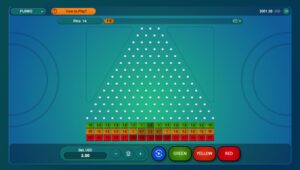
The risk selector is one of the more effective pieces of UI in instant-win games, because it gives the impression of control over a result that is still entirely random. Choosing “high risk” feels like a strategic decision, even though it only reshapes variance rather than improving expected value.
This is compounded by near-miss design: a ball settling one slot away from a huge multiplier reads as a close call rather than the random bounce it actually was — exactly the mechanism that keeps players adjusting settings round after round in search of a pattern that does not exist.
Weighed against other instant-win titles in this category, Plinko’s main appeal is transparency rather than excitement — there is no climbing multiplier to read, just a clean, checkable drop.
Plinko earns its place in a casino games rotation as a quick, transparent instant-win title rather than a game you can out-think. The official 97% RTP and a genuinely checkable provably fair system make it one of the more honest options in this category — the real decision left to you is simply how much variance you want to sit through to get there.






Independent casino game and operator reviews — real RTP data, honest mechanics breakdowns and bonus details, verified wherever we could confirm them. 18+. Gamble responsibly.